
I'm Teaching Asexuality Studies
Follow along with me

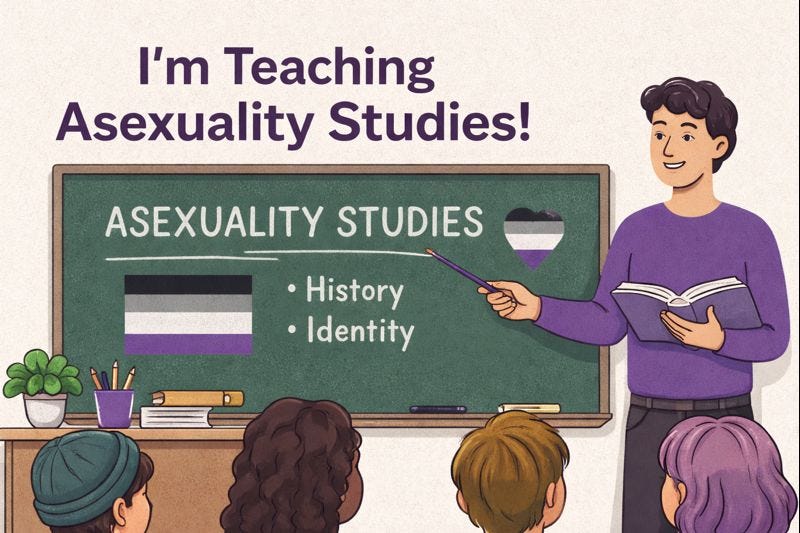
This semester I get to teach an unusual course: Asexuality and Aromanticism Studies.
I’m excited not only because I get to spend an entire semester discussing my research area with passionate undergraduate students, but also because of how cutting-edge these topics still are in the classroom.
There are only a handful of other times any university has offered a course specifically focusing on asexuality or aromanticism. That means despite the recent boom in academia’s interest in asexuality, I’m one of the first professors in world to offer a semester-long course focusing entirely on asexuality and aromanticism.
I wanted to share this with you all because I want to offer a chance to follow along this semester.
Obviously I can’t offer the full experience of the course. Like most of my courses, it’s discussion based—and a significant focus of the course is forging a classroom community, while also learning skills that help students continue to foster and build community even after they leave the classroom.
But my goal is, for the next 14 weeks, to share the reading our class is discussing for the week and some ideas that emerge from our discussion that I found particularly interesting or important.
Let’s get to it.
Week One: An Introduction
For week one, I asked students to read my recent article in Sociology Compass “Understanding Asexuality: A Sociological Review.” You can read more about that article and find a link to access it for free here. The article lays out what we currently know, from a sociological perspective, about asexuality. It also lays the groundwork for considering how asexuality intersects with race, disability, gender, medicine, and other elements of our social world.
There are two main ideas we discussed in class that I want to highlight for all of you:
1. Why should we care about asexuality?
As I discuss in my Sociology Compass article, most estimates of how much of the general population is asexual hover around 1-2%. Asexuality is a marginal identity. So why should we care about it?
As I’ve explained before, it is precisely asexuality’s marginality that makes it so valuable to study. (And this is putting aside the fact that even if asexuality is just 1% of the population, that’s still tens of millions of people.)
Here I’m drawing on arguments particularly from Black scholars, who have powerfully demonstrated that the margins of society hold invaluable knowledge that we would miss if we focused only on “normal” parts of society.
I explained to students that this idea is adjacent to what foundational Black sociologist W.E.B. DuBois is getting at through his concept of double consciousness. DuBois helps us see that Black people in America are pushed not only to understand their own marginalized experience of life in America: they are also pushed to understand more dominant (i.e. white) perspectives. This provides Black Americans with a double consciousness: they can perceive a broader range of reality than white Americans are generally socialized to perceive.
Another important point here is that this double consciousness allows Black Americans to more deeply understand how race structures the lives of all Americans, not just those who are Black. White people’s lives are also profoundly shaped by race—but Black people are often better positioned to understand that than white people are.
In class we discussed how this general idea of double consciousness—and of the value of marginal knowledge—can be transposed to various other perspectives, including asexual perspectives.
Asexuality, as I’ve explained, is marginalized in both heteronormative and queer spaces. This positions asexuality as posing invaluable interventions in our ability to understand and more deeply perceive the world all of us live in.
In other words, I’m challenging the idea that we should study asexuality only as a gesture toward equity, essentially as an act of intellectual charity.
I’m arguing that we should study asexuality because it will help us to see social dynamics (like compulsory sexuality, a concept we’ll discuss in future weeks) that affect all of us—but that we potentially couldn’t see until we centered asexuality in our analysis. Studying asexuality will help all of us.

2. What does a sociological lens on asexuality provide?
We also discussed how the ideas above about asexuality as a valuable form of marginal knowledge connects specifically to sociology.
Sociology is the study of society. So bringing a sociological lens to the study of asexuality means that we can draw on asexual perspectives to better understand the role of sexuality—and race, gender, disability, medicine, etc.—in our social fabric.
The sociology of asexuality can help us see the role of sexuality in shaping our relationships, our culture, our institutions. It can help reveal powerful social dynamics that have been with us all along, but that we couldn’t see because they have been beneath the veil of “common knowledge.”
I think this is a particularly pressing task as many of us are confronting the reality that our society is deeply broken. An indispensable part of revolutionary politics—and even more mild reform-oriented politics—is imagining different, positive futures. Asexuality needs to be part of that imagining.
I’m looking forward to the rest of this semester, and to sharing highlights with you (hopefully!) every week. Thanks for sticking around.
Canton Winer is an Assistant Professor of Sociology and Women, Gender, and Sexuality Studies at Northern Illinois University. His research focuses on the relationships between gender and sexuality, with specific focus on the experiences and perspectives of people on the asexuality spectrum. You can keep up with his research on Bluesky.
Want to support my research on asexuality? Consider becoming a contributing subscriber by clicking on the button above. I am committed to keeping my work free, without paywalls. Consider your paid membership a token of appreciation, an investment in research on asexuality, and a small but meaningful way to join a community that shares your interests.
I can’t wait to read more this is really helpful for me. Thank you for sharing
Congratulations! This is amazing - I look forward to following along with your teachings. I have shared your sociological review with folks who are curious to learn more about Asexuality, and I can't wait to see what you have in store for this semester. Happy teaching!!!!